
Climate & Air Quality Transition Pathways
Designing practical, scalable pathways for structural emissions reduction.
Integrated transition modeling to identify technically feasible, economically grounded, and institutionally realistic emissions pathways.
What We Do:

Sectoral Decarbonization Modeling
We model sector-specific emissions reduction pathways across energy, transport, industry, and waste systems.
- Energy and transport modeling
- Waste and circular systems
- Industrial emissions pathways

Circular & Resource Efficiency Modeling
We evaluate material flows and circular economy interventions to identify scalable co-benefits for air quality and climate.
- Material flow analysis
- Waste-to-energy evaluation
- Co-benefit assessment

Infrastructure & Investment Alignment
We assess how infrastructure planning, regulatory design, and institutional capacity shape transition feasibility.
- Capital planning integration
- Regulatory feasibility analysis
- Phased implementation strategies
Why Structural Transitions Matter
Air pollution and climate change are driven by structural features of energy, transport, waste, and industrial systems. Temporary interventions may reduce emissions at the margin, but durable improvements require system-wide transformation.
Transition planning must consider:
- Sector interdependencies
- Infrastructure constraints
- Equity and exposure disparities
- Implementation capacity
Case Example: Circular Transition Pathways for Clean Air and Low-Carbon Growth in India
Why city-only action plans can’t deliver city air-quality targets.
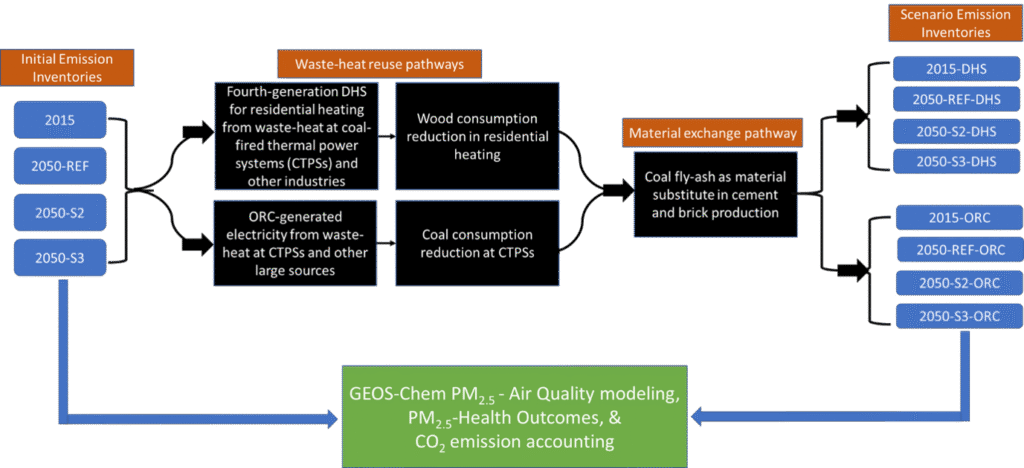
We evaluated circular transition strategies in India—district heating from industrial waste heat, organic Rankine cycles for waste-heat-to-power, and coal fly-ash material exchange—using scenario-based emissions, GEOS-Chem, and health impact assessment. Results show small nationwide PM₂.₅ improvements but larger benefits for CO₂ reductions and avoided premature mortality, especially under waste-heat-to-power pathways.
- Scenario framework: 2015 baseline + 2050 pathways under varying policy adoption
- Methods: Emissions scenarios → GEOS-Chem PM₂.₅ → population-weighted exposure + health impacts
- Findings: DHS yields limited nationwide PM₂.₅/CO₂ changes; ORC provides larger CO₂ reductions and health benefits
- Circularity add-on: Fly-ash reuse potential exists to absorb unused fly-ash in cement/brick production
Read the peer-reviewed article (open access):
Impact of Circular, Waste-Heat Reuse Pathways on PM2.5-Air Quality, CO2 Emissions, and Human Health in India: Comparison with Material Exchange Potential
🌍 Transition pathway modeling reveals where structural interventions can reduce pollution, mitigate climate risk, and improve equity at scale.